

Automated and connected driving

Technologies and usage concepts for automation and connectivity in mobility and transport represent an ongoing trend in research and development—one that has recently been shifting increasingly toward applications in regular operation. The potential of automated driving is enormous and could lead to a fundamental transformation of transport structures, mobility services, and mobility behavior; at the same time, however, significant challenges remain regarding technical development, regulatory approval and areas of application, infrastructure expansion, and the design of procurement and operational models as well as data spaces. Navigating this complex landscape, ThIMo addresses automated and connected driving (AVF) not merely through specific engineering aspects of research and development—such as sensor and wireless transmission technologies—but treats it fundamentally as a core element of the digital mobility of the future, employing an interdisciplinary approach that spans key areas of expertise.
- How must operational domains be defined, analyzed, and—where necessary—upgraded in terms of infrastructure to ensure the safe and efficient operation of highly automated and connected vehicles?
- What measures can further enhance the performance of highly automated and connected vehicle technologies, particularly regarding perception, software, and control systems?
- What hurdles must be overcome to transition from research projects and pilot operations to regular service, and which stakeholders need to be involved in this process?
- How can Thuringia be developed into a hub for research and application in the field of highly automated and connected vehicles, and how can it establish effective governance structures involving stakeholders from industry, academia, cities, municipalities, and the political sphere?
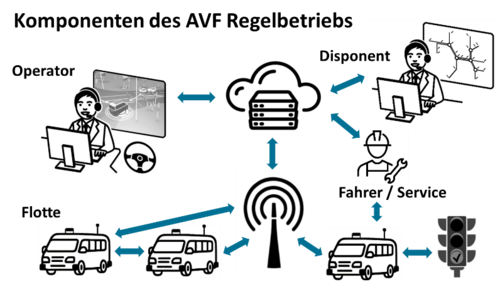
As expectations for market-ready and scalable AVF solutions rise, ThIMo plays a vital role in transitioning AVF technologies into regular operations by leveraging research resources such as its AVF fleet, digital testbeds, living labs, and the AVF Atlas, alongside its contributions to the Thuringia AVF Competence Center. We view the specific polycentric and rural character of Thuringia, the advanced planning of the state-wide integrated regular-interval timetable (ITF 2030), and a focus on public transport applications as the DNA of our model region; we contribute our AVF expertise to the Thuringia Mobility Network (TMN) and the European Digital Innovation Hub (EDIH) Mid Germany. Similarly, the AVF Competence Center initiated under the BMFTR project MOVEwell, participation in the nationwide "Ecosystem Mobility 4.0" alliance, and numerous other collaborative projects at the federal and EU levels all align with a strategic AVF action plan.